Commercial Moves in Battersea
If your business is planning a relocation, expansion, internal reconfiguration, or a phased move, Commercial Moves in Battersea needs a practical, well-organised approach from the start. In a busy part of southwest London like Battersea, timing, access, building rules, and minimising disruption all matter. Whether you are moving a small office, a retail unit, a studio, a clinic, or a larger commercial workspace, the right team can help you keep operations running while the move is carried out safely and efficiently.
Battersea has a mix of modern developments, refurbished commercial spaces, riverside offices, high-street premises, and older properties that can present unique moving challenges. Narrow roads, shared loading bays, lift access, controlled parking, and busy traffic around Clapham Junction, Nine Elms, and the wider Wandsworth area all need to be planned around carefully. That is why businesses often look for a local commercial removals service that understands the area and can work around real-world constraints.
From the first survey through to unpacking and setting up the final workstation, a good commercial move is about much more than simply transporting boxes. It is about careful planning, clear labelling, business continuity, secure handling of equipment, and a move schedule that fits your working day. If you are comparing options for office relocation in Battersea or need a dependable team for a larger commercial transfer, this page explains what to expect and how to prepare.
Local Commercial Relocation Support for Battersea Businesses

Battersea is home to a wide range of business types, each with different needs. A creative agency in a converted warehouse may have large monitors, design equipment, and archive storage. A professional services office may need secure handling of desks, filing cabinets, and sensitive paperwork. A shop on a busy local street may need a move planned outside trading hours. A medical, therapy, or consultation space may need a calm, discreet, and tidy relocation to protect confidential materials and specialist furniture.
Commercial removals in Battersea should reflect those differences. A one-size-fits-all approach rarely works well for businesses because the priorities are not always the same. Some customers want speed above all else. Others need a phased transition to avoid downtime. Many want help with dismantling, reassembly, crate hire, document handling, or the move of IT equipment. A reliable local team can build the service around your schedule rather than forcing you into a rigid process.
Working locally also helps when the move involves tight access or specific building rules. Battersea has plenty of places where loading windows are limited, parking is controlled, and lift bookings have to be arranged in advance. A team that regularly works in and around Battersea, Clapham, Wandsworth, Nine Elms, Vauxhall, and Chelsea understands the practical details that can make the difference between a smooth move and a stressful one.
Why Commercial Moves in Battersea Need Careful Planning
Commercial relocations are usually more complex than domestic moves because there are more moving parts. You may need to protect confidential files, label departments, disconnect and reconnect technology, move desks without damaging flooring, or keep staff disruption to a minimum. If you are running a customer-facing business, you may also need the move completed outside opening hours or in stages over several days.
Commercial Moves in Battersea often involve properties with different access conditions. Some premises are located in new-build developments with concierge rules and booking systems for lifts and loading areas. Others are in older commercial buildings where stair access, shared entrances, or awkward internal layouts make lifting and manoeuvring more difficult. A local mover who understands these conditions can plan the route, equipment, and vehicle size accordingly.
There is also the matter of timing. Battersea traffic can be busy at peak hours, and some roads are more challenging for larger vehicles. Choosing a company that understands how to work around local congestion, parking rules, and delivery slots can save valuable time. This matters whether you are moving a small office near Battersea Park, a retail premises close to main routes, or a workspace closer to the river and the redevelopment zones around Nine Elms.
What Is Typically Included in a Commercial Move

The exact service will vary depending on your business and the amount of equipment involved, but a well-organised commercial move usually includes a number of core steps. These may be adapted for office removals, retail relocations, hospitality spaces, and specialist business premises.
Typical inclusions may involve:
- Pre-move planning to understand the size, layout, and timing of the relocation
- Site assessment to identify access, parking, lifts, stairs, and loading requirements
- Packing support for office items, stock, files, and equipment
- Furniture dismantling and reassembly where needed
- Secure transport of items using suitable vehicles and protective equipment
- Labelling and room-based organisation to help with placement at the new site
- Special handling for delicate, heavy, or high-value equipment
- Internal moves if you are reorganising within the same building
- Optional out-of-hours work to reduce interruption to business activity
Some moves also require the relocation of archive boxes, display units, reception furniture, shelving, safes, conference tables, and specialist machinery. In those cases, it is helpful to have a team that can assess the practicalities before move day and advise on any extra preparation that may be needed.
The most effective moves are the ones that start with a clear plan. This is especially important if several departments need to move in stages, or if you need a same-day handover between locations.
Types of Businesses We Commonly Help
Commercial relocation in Battersea covers many sectors, and each one has slightly different priorities. Office moves are often focused on IT, desks, chairs, meeting tables, and files. Retail moves may involve stock, fixtures, point-of-sale equipment, and displays. Hospitality businesses may need support with tables, stools, storage, and back-of-house items. Studios and creative spaces often require careful handling of screens, audio equipment, artwork, and fragile materials. Professional practices may need secure, discreet handling of paperwork and specialist furniture.
Businesses around Battersea Power Station, Lavender Hill, St John’s Hill, Queenstown Road, and surrounding commercial pockets may all face different access issues. Some areas have busy pedestrian traffic. Others may require careful coordination with building management. A good local team can adapt to those details and provide a move that fits the site rather than disrupting it.
It is also worth remembering that not every move is a full relocation from one building to another. Many businesses need internal office moves, a department shuffle, storage room reorganisation, or a phased upgrade of premises. These projects can be just as demanding because they still require clear planning, handling care, and minimal disruption to staff and visitors.
How the Service Works

A structured process helps keep everything manageable. While every move is different, a typical commercial moving service in Battersea follows a clear sequence designed to reduce risk and keep your business informed.
1. Initial discussion and move requirements
This is where you explain the size of the move, the type of premises, the timing, and any special items that need attention. It is the stage to mention IT equipment, filing systems, fragile stock, access restrictions, or deadlines tied to opening times and lease changes.
2. Survey and planning
A site survey helps identify what will be moved, how it should be packed, and whether any obstacles need to be accounted for. This may include stairs, tight corridors, lift sizes, limited parking, or loading constraints. In Battersea, local parking and access arrangements can be especially important, so the planning stage should never be rushed.
3. Preparation before moving day
This may involve supplying crates or boxes, marking rooms or departments, preparing labels, disconnecting certain items, and separating essential documents or valuables that require extra handling. If furniture needs dismantling, it can be organised in advance so the move runs efficiently.
4. Moving day execution
On the day, the team should work in a logical sequence, protecting floors and doorways where necessary, loading items safely, and making sure the right equipment reaches the right destination. For business moves, timekeeping matters just as much as care, especially if you are working to a deadline.
5. Delivery, placement, and setup
At the new location, items can be placed into the correct rooms or zones, helping staff get back to work faster. Reassembly can often be carried out as part of the service, reducing the amount of work your team has to do after the move.
6. Final checks
A quick review at the end helps make sure all key items have arrived, the layout is correct, and any outstanding tasks are noted. For many companies, this is the point where the move begins to feel complete and business can settle into the new space.
Preparing Your Battersea Business for the Move
Good preparation helps the move run faster and reduces the chance of confusion on the day. Even if you are using an experienced team, your own organisation still plays a major part. The more clearly items are labelled and departments are briefed, the easier it becomes to move in an orderly way.
A practical preparation checklist for commercial moves in Battersea might include:
- Confirming the move date, access times, and any building restrictions.
- Notifying staff of their responsibilities and packing deadlines.
- Back up digital files and secure important data in advance.
- Separate confidential documents for safe handling.
- Label boxes by department, room, or workstation.
- Identify items that must be moved first and items that can travel later.
- Remove loose personal belongings from desks and drawers.
- Make sure fragile items are marked clearly.
- Plan for waste removal or disposal of unwanted furniture.
- Keep a small essentials kit for the first day in the new premises.
Clear labelling is one of the simplest ways to reduce stress. If you can label crates by team, floor, or destination room, the unloading process becomes more organised and your staff can settle in much quicker.
It is also helpful to decide in advance what should be disposed of, recycled, stored, or moved. Commercial moves often reveal old furniture, duplicate equipment, or archived items that no longer need to take up space. Reviewing these items before move day can save time and avoid transporting things you do not actually need.
Access, Parking, and Local Movement Challenges in Battersea
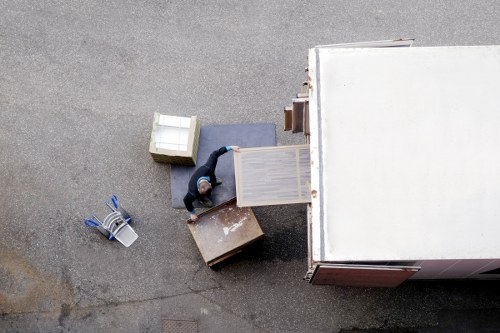
One of the biggest reasons businesses choose a local mover is the practical knowledge of the area. Battersea can be straightforward in some locations and unexpectedly tricky in others. Loading access may be limited by road layout, time restrictions, resident permits, commercial bays, or shared access arrangements. In new developments, there may be strict rules for vehicle arrival and lift use. In older streets, there may be narrow approaches and fewer places for larger vehicles to wait.
These details matter because a commercial move can quickly lose time if the vehicle cannot park near the entrance, if lifts are unavailable, or if furniture must be carried further than expected. A local team that regularly works in Battersea and nearby districts can factor these issues into the schedule. That means fewer surprises and a better chance of staying on time.
Nearby areas such as Clapham, Wandsworth, Nine Elms, Vauxhall, Pimlico, and Chelsea also present varied access conditions. If your business is moving between Battersea and another part of south or west London, route planning becomes even more important. Traffic patterns, bridge crossings, delivery windows, and building access times all influence how the move should be carried out.
This is where local knowledge saves practical time. It is not just about the shortest route; it is about the route that works best with your building, your schedule, and the vehicle size needed for the job.
Why Businesses Choose a Local Company
Choosing a local commercial removals company in Battersea can offer real advantages. First, a local team is usually more familiar with the layout of the area, which helps with planning. Second, response times for surveys, packing support, and move-day logistics are often easier to arrange when the team is nearby. Third, local firms are often better placed to handle smaller urgent jobs, phased moves, or repeat work across multiple sites.
For many customers, the key benefit is peace of mind. You want a company that understands that your move is not just about furniture—it is about keeping your business functioning, protecting your assets, and helping your staff settle in without unnecessary disruption. A local service can be more flexible with timings and more responsive when plans change, which is often important in the real world of commercial property moves.
Local experience matters most when the move becomes complicated. If access changes, lift bookings shift, or you need to coordinate with building management, a team that knows Battersea can adapt more quickly than one travelling in from farther away without area familiarity.
Commercial Move Types We Support
Commercial moves are not all the same. Some are simple and compact. Others involve multiple rooms, heavy items, or careful sequencing. Below are common types of relocation work that businesses in Battersea often request.
- Office moves for small, medium, and larger workspaces
- Retail relocations including shop fittings and stock
- Internal office moves and rearrangements within the same premises
- Studio and creative workspace moves
- Professional practice relocations such as consultancies, clinics, and agencies
- Archive and document relocation
- Furniture dismantling and reassembly
- Multi-site business moves where departments relocate separately
- Out-of-hours and weekend moves where timing is critical
Some businesses also need support with storage runs, equipment deliveries, or moving items between floors and departments. If your project has a few unusual requirements, it is usually best to discuss them early so the move can be planned properly rather than improvised at the last minute.
For businesses that cannot afford avoidable downtime, planning is not optional; it is part of the service.
Pricing Factors to Consider

Business owners often want to know what affects the cost of a commercial move, even if they are not expecting an exact price upfront. While exact quotations depend on the details of the job, several common factors usually shape the overall cost and schedule.
Typical pricing factors include:
- The size of the premises and the amount of furniture or equipment
- The distance between the old and new locations
- Access conditions such as stairs, lifts, loading bays, and parking restrictions
- Whether packing, dismantling, and reassembly are required
- Special handling needs for heavy, fragile, or confidential items
- Out-of-hours or weekend timing requests
- The number of staff required on the day
- Any storage or phased move arrangements
In Battersea, access and timing can have a significant effect because some sites are easier to service than others. A building with good loading access and a straightforward route may be quicker to move than a premises where items must be carried longer distances or where vehicle access is tight. That is why an accurate survey or detailed discussion is so useful before booking.
When requesting a quote, it helps to be honest about what needs to move. Businesses sometimes underestimate the number of crates, boxes, filing systems, and small items involved. A clearer inventory usually leads to a more accurate plan and a smoother move day.
What to Ask Before Booking
If you are comparing commercial moving services in Battersea, it is sensible to ask a few practical questions before confirming anything. The aim is to make sure the service matches your building, your timescale, and your business needs.
Useful questions include:
- Have you handled moves in Battersea or nearby business districts before?
- Can you work outside standard office hours if needed?
- Do you offer packing materials or crate hire?
- Can you dismantle and reassemble office furniture?
- How do you handle fragile, confidential, or high-value items?
- Can you help with internal moves as well as full relocations?
- What information do you need to provide an accurate quote?
- How do you manage access, parking, and building restrictions?
Asking these questions early helps you compare services on more than just the initial headline. It also helps you identify whether a company understands the realities of business relocation rather than simply offering a basic transport service.
Book your service now if your move date is approaching and you want to secure a team that can plan ahead with you. Early planning usually makes the whole process easier, especially in a busy area like Battersea where building access and scheduling can be tightly managed.
Areas Covered Around Battersea
A local commercial moving service is often used by businesses across Battersea and surrounding parts of southwest and central London. Common areas include Battersea Park, Nine Elms, Clapham Junction, Lavender Hill, Queenstown Road, Wandsworth, Clapham, Vauxhall, Chelsea, Pimlico, and nearby riverside developments. Depending on your move, the service may also support transfers between offices, retail spaces, and warehouses across wider London locations.
Because Battersea sits close to several busy business and residential zones, many moves involve journeys that must be timed to avoid congestion and coordinate with building access. A nearby team can help plan around that more effectively and may be better suited to repeat moves, multi-stage relocations, or internal adjustments carried out over several dates.
If your business is relocating from one local site to another, or from Battersea to another area nearby, it helps to work with a company that already understands the mix of residential streets, commercial corridors, and regenerated developments in this part of London.
Frequently Asked Questions
How far in advance should I book a commercial move?
It is best to book as early as possible, especially if you need a specific date, out-of-hours work, or coordination with building management. Larger or more complex relocations usually benefit from longer lead times.
Can you move our office outside working hours?
Many businesses prefer evening, weekend, or other out-of-hours moves to reduce disruption. Availability depends on the move details, so it is worth raising this during the first discussion.
Do commercial moves include packing?
They can. Some businesses prefer to pack internally, while others want help with crate supply, packing support, or full packing services for files, stock, and office contents.
What if we only need part of the office moved?
Partial relocations and internal office moves are common. You may only need certain departments, meeting rooms, or furniture items moved, and a commercial removals team can usually work to that brief.
How do you handle fragile or confidential items?
These items should be identified early so they can be packed and transported appropriately. Confidential documents may need separate handling, while fragile equipment may require extra protection and careful placement on arrival.
Can you help if our building has difficult access?
Yes, but the access details need to be known in advance. Narrow roads, restricted parking, lifts, stairs, and concierge-managed buildings can all affect the move plan, which is why a survey or detailed briefing is valuable.
What should we do before the movers arrive?
Label items clearly, separate any items that are not moving, back up data, protect sensitive documents, and brief staff on the move schedule. A preparation checklist is one of the easiest ways to make the day run more smoothly.
Ready to Arrange Your Move?
If you are planning Commercial Moves in Battersea, the best next step is to request a quote and talk through the details of your premises, your dates, and your access requirements. Whether you are moving a small office, a retail unit, a studio, or an entire business floor, the right planning can make the relocation feel much more manageable.
Choosing a local team means choosing practical support that is shaped around Battersea’s roads, buildings, and business environment. That includes a smarter approach to parking, timing, loading, and setup at the destination. It also means having a service that understands the pressure businesses face when they need to relocate with minimal interruption.
Contact us today to request a free quote, discuss your move, or arrange a suitable time to get started. If you want a move that is organised, efficient, and tailored to your business needs, book your service now and take the stress out of relocation planning.